


Add a Battery to Your Existing Solar System (2026 Guide)
It is 6 p.m. in June. Your panels carried the whole house all day and are now winding down right as your utility flips into its most expensive window. The power you made at noon is gone, sold back to the grid for pennies, and you are about to buy it back at peak rates. You solved the morning and left the evening unsolved.
If you have solar, this gap should bother you. Yes, you can add a battery to your existing solar system, and in 2026 AC coupling makes it simpler than ever, usually without touching the solar inverter on your house. But "can I?" is the easy question. What decides whether this is worth your money is what kind of battery and control system you add — a dumb battery and a smart one cost similar money for very different outcomes.
That is the gap every installer guide leaves open: they answer "yes, you can" and route you to a quote form. None of them answer the question that matters once the battery is in: who is managing it? This guide does — across inverter scenarios, 2026 costs, sizing, incentives, and the control layer that separates a battery box from a smarter home.
Key Takeaways
- Yes, you can add a battery to an existing solar system using AC coupling, which connects the battery to your home's AC wiring without replacing the solar inverter already installed [4].
- California's residential rate averaged 32.54 cents per kWh in 2025 and ran about 35.25 cents in April 2026, well above the 17.3-cent 2025 national average — making stored solar far more valuable than grid power at evening peak (EIA, verified as of April 2026) [1][2].
- A single AC-coupled battery retrofit typically costs $10,000 to $18,000 installed in 2026, and there is no federal 25D tax credit for batteries installed after December 31, 2025 (IRS / OBBBA, verified 2026-06-27) [6][9].
- California's ratepayer-funded SGIP budgets closed to new applications December 31, 2025; the AB 209 state-funded RSSE pathway has limited openings, with most sub-tiers waitlisted by mid-2026 and some Non-POU tiers still accepting applications (CPUC SGIP program metrics, verified 2026-06-27) [7][8].
- Kora Powerblocks pair a hybrid inverter with LFP storage in one outdoor-rated tower, support AC-coupled solar through the Smart Panel, and scale from 8 kWh to 112 kWh across four towers (Kora tech specs, June 2026) [11].
Can You Add a Battery to Your Existing Solar System?
Yes. In most cases, you can add a battery to a grid-tied solar system using AC coupling, which connects a battery and its own inverter to your home's AC wiring downstream of the existing solar inverter — no existing solar hardware needs replacing [4]. Installation time varies by site, so have your installer scope it first.
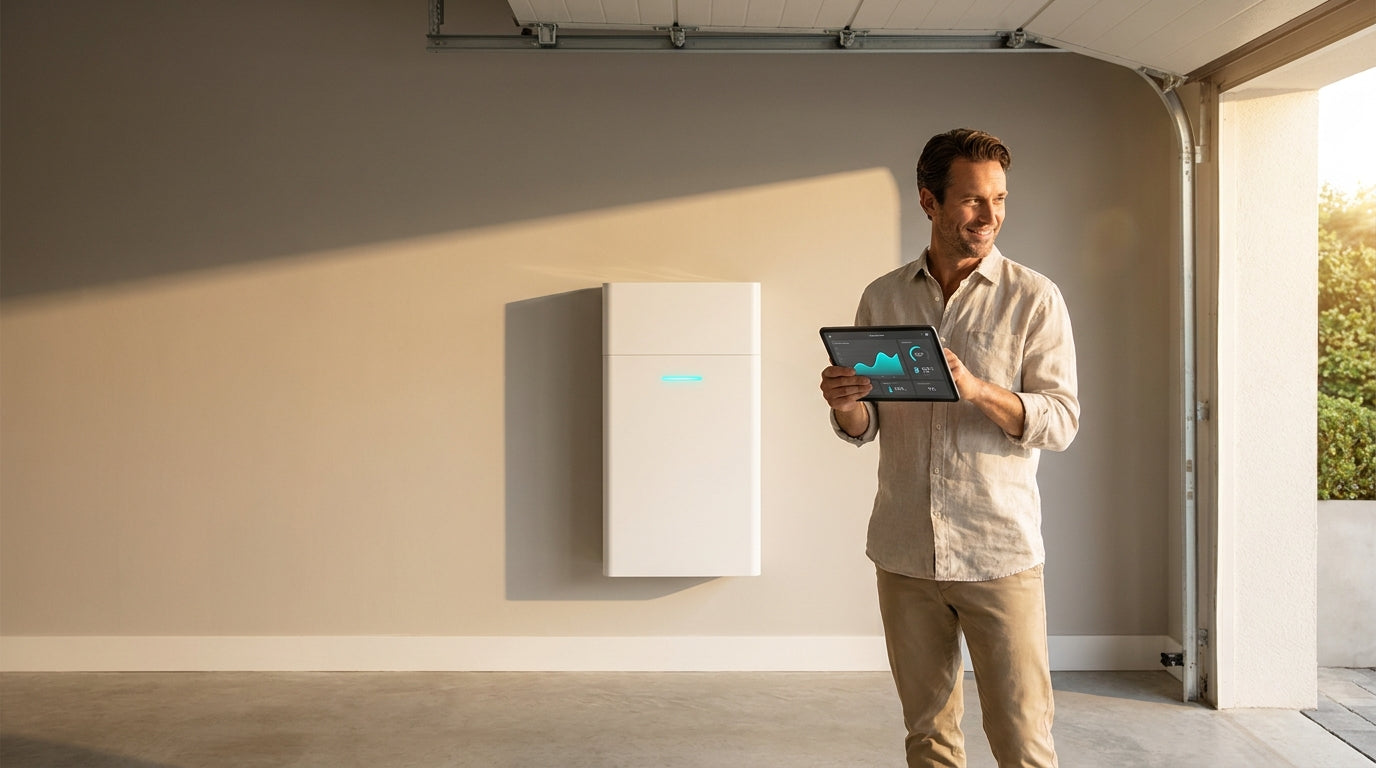
Think of it as Phase 2 of the same upgrade. Solar was Phase 1: generation on the roof. Storage with whole-home control is Phase 2: a way to decide what to do with that power — store it, spend it, or hold it in reserve — capturing more of the value your solar produces.
Solar panels generate power. A battery and a control layer decide what to do with it. Phase 1 and Phase 2 of the same upgrade.
Which path you take depends on the inverter you already have. Here are the three starting points.
Do I Need to Replace My Inverter to Add a Battery?
Usually no. With AC coupling, the battery brings its own inverter and ties into your home's AC panel, so your existing solar inverter stays in place [4]. You only replace it for DC coupling, or if your inverter is already near the end of its 10-to-15-year service life [3].
You Already Have a Hybrid or Battery-Ready Inverter (Best Case)
If your inverter is already battery-compatible — common in systems installed from 2021 onward — the installer can connect a battery to its existing DC or AC bus with minimal new hardware, because the conversion electronics are already in place [4]. Check your model number against the spec sheet, or ask your installer.
For homeowners on an older setup, Kora Powerblocks include an all-in-one hybrid inverter rated 11.4 kW continuous and 18 kW peak, so the tower is the battery's inverter — a fresh platform instead of capacity bolted onto aging conversion hardware [11].
You Have a Standard String Inverter (Most Common Scenario)
Most US solar homeowners have a standard string inverter, and for them AC coupling is the path: a battery with its own inverter joins the AC panel as a second source, so your panels and inverter keep doing what they already do [4][11].
This is where a control layer earns its keep. The Kora Smart Panel manages the battery, the AC-coupled solar input, and up to 12 load circuits from one device, with a dedicated AC-PV circuit for this retrofit [11]. Instead of bolting a battery on the wall and hoping it behaves, you give the home one brain.
One firm rule: all AC coupling, interconnection, and panel work must be performed by a licensed electrician or authorized installer. Do not attempt electrical work yourself, and never open enclosures or touch energized equipment.
You Have an Older or Unsupported Inverter (Still Possible, With a Review)
If your inverter is more than 10 to 12 years old, it may be approaching end of life, since residential string inverters generally last roughly 10 to 15 years [3]. That makes a retrofit the natural moment for a double upgrade: add storage and refresh the conversion hardware in one visit.
AC coupling still works here, but the economics shift if a new inverter is also needed, so your installer should run a site-specific review first — an aging inverter is a reason to upgrade now, not to wait.
What Is AC Coupling and Why Does It Matter for a Retrofit?
AC coupling connects a battery system to the alternating-current (AC) side of your home's wiring, between the solar inverter's output and the panel. Because the battery has its own inverter, it operates independently — nothing about your existing solar has to change [4].
The energy flow is simple, and it runs in four steps [4]:
- Your panels make DC power.
- Your existing solar inverter converts it to AC.
- The battery charges from that AC bus.
- The battery discharges back on demand.
DC coupling instead wires the battery directly to the array's DC side through one hybrid inverter — slightly more efficient, but it requires replacing your solar inverter, which turns a battery add-on into a full-system replacement [4].
AC coupling preserves the solar you already paid for. DC coupling is a little more efficient, but you buy that efficiency with a new inverter.
That efficiency gap is single-digit and rarely changes the decision: the cost you avoid by keeping your working solar inverter dwarfs those few points over any payback window [4].
The honest takeaway: for an existing solar home, AC coupling wins almost every time — it preserves working equipment, installs faster, and usually avoids re-permitting the array. Kora Powerblocks connect through the Smart Panel's AC-PV circuit, with no modifications to the solar inverter or array [11].

AC coupling preserves your existing solar hardware and lowers retrofit cost; DC coupling is more efficient but requires a full inverter replacement.
| Factor | AC Coupling | DC Coupling |
|---|---|---|
| How it connects | Battery + own inverter to home's AC bus [4] | Battery to solar DC side via one hybrid inverter [4] |
| Replace solar inverter? | No [4] | Yes [4] |
| Round-trip efficiency | Slightly lower (extra conversion stage) [4] | Slightly higher (skips a stage) [4] |
| Typical added cost ($) | $10,000–$18,000 [9] | $15,000–$22,000 [9] |
| Best for | Existing solar homes (most retrofits) [4] | New solar-plus-storage builds [4] |
| Kora fit | Powerblocks via Smart Panel AC-PV circuit [11] | Powerblocks hybrid inverter (new build) [11] |
The hardware on your roof does not care which path you pick. Your wallet and your timeline do.
How Much Does It Cost to Add a Battery to an Existing Solar System?
Adding a battery to an existing solar system via AC coupling typically costs $10,000 to $18,000 installed in 2026, depending on brand, capacity, labor, and any panel upgrades [5][9]. That all-in figure covers six line items [4][5]:
- Battery hardware — the cells and enclosure themselves.
- Battery inverter — the conversion electronics that let an AC-coupled battery talk to your panel.
- Smart Panel (if included) — the control layer that manages circuits and charge.
- Labor — the licensed install and commissioning.
- Permits — local building and electrical sign-off.
- Utility interconnection amendment — the paperwork that adds storage to your existing solar agreement.
The sticker on the battery is half the story. Labor, permits, and the interconnection amendment are the other half, and they are where quotes quietly diverge.
A widely cited installer-marketplace estimate puts the average retrofit near $15,228 (a market reference, not a primary cost source) [9]. For comparison, a single Tesla Powerwall 3 runs roughly $13,000 to $16,000 installed in 2026 (pre-incentive) and supports AC coupling to third-party inverters at a max of 7.68 kW AC per standalone unit [10][12]. Powerwall specs are cited for comparison only; Kora does not endorse or resell competitor hardware.
One number to stop budgeting for: the federal tax credit. The 30% Residential Clean Energy Credit (Section 25D) ended for any installation completed after December 31, 2025, so there is no federal homeowner credit for a standalone battery in 2026 — the full incentive picture is below [5][6].

A single AC-coupled battery retrofit runs $10,000–$18,000 installed; adding a Smart Panel and modular storage builds whole-home control into the same investment.
| Scenario | Installed Cost ($) | Battery Capacity (kWh) | Smart Panel Included | Federal Credit (2026) | Notes |
|---|---|---|---|---|---|
| AC-coupled single battery (e.g., 3× Enphase IQ 5P) | $12,000–$16,000 [9] | ~15 [14] | No | None [6] | No load control |
| Tesla Powerwall 3 retrofit (AC-coupled) | $13,000–$16,000 [10] | 13.5 [12] | Gateway 2 only [12] | None [6] | Pre-incentive installed cost; spec for comparison only |
| Kora Powerblocks + Smart Panel (base) | Verify with Kora [11] | 8 base, expandable to 112 [11] | Yes (12 circuits) [11] | None [6] | Whole-home circuit control |
| DC-coupled (full hybrid inverter swap) | $15,000–$22,000 [9] | Varies | Depends | None [6] | Requires inverter replacement |
A bare battery is the cheapest line item, but it leaves your home exactly as un-managed as before. The difference between a $14,000 box and a $14,000 system is not the cell count — it is whether your home gains a brain or a bigger tank.
What Size Battery Do I Need for My Solar System?
Size your battery from three inputs: your daily energy use, how many hours of backup you want, and whether you are optimizing for time-of-use bill savings, backup duration, or both [13]. Nail those three and the right kWh number falls out cleanly.
The average US home used about 29.6 kWh per day in 2022 (10,791 kWh for the year), per the EIA's residential electricity-use FAQ [13], and you almost never back up all of it. Essentials-only coverage (fridge, lights, phone, fan) draws roughly 500 to 800 watts, while heavy loads like HVAC and EV charging eat capacity fast (see below).
You rarely need to back up your whole house. You need to back up what matters, for as long as the outage lasts. Those are two very different battery sizes.
For bill savings rather than backup, size to your peak window. California's evening peak runs 4 to 9 p.m., and at 32.54 cents per kWh in 2025 (about 35.25 cents by April 2026, per EIA), every kilowatt-hour you shift out of that window is worth real money [1]. Aim for enough to carry your evening load through peak — the self-consumption math NEM 3.0 made urgent, covered in our NEM 3.0 explainer.
Here is the argument installer guides skip: size for tomorrow, not just today. EV adoption and heat-pump electrification both raise household load, so today's baseline may need revisiting in a few years. Kora Powerblocks scale from 8 kWh to 112 kWh, so you add capacity later without replacing the inverter or panel [11].

Most homes need 10–20 kWh for essential-load backup; whole-home backup or EV charging requires 30 kWh or more.
| What You Want to Back Up | Typical Load (W) | Hours of Backup (13.5 kWh) | Hours of Backup (28 kWh) | Recommended Min. Battery (kWh) |
|---|---|---|---|---|
| Essentials only (fridge, lights, phone, fan) | 500–800 | 16–24 | 35–55 | 8–10 |
| Essentials + limited HVAC (fan only) | 1,200–1,800 | 8–11 | 15–22 | 13–15 |
| Full HVAC on/off cycling | 3,000–4,000 | 3–4.5 | 7–9 | 20–28 |
| Whole-home incl. EV charging | 5,000–8,000 | 1.5–2.5 | 3.5–5.5 | 30+ |
Load figures are illustrative ranges based on EIA household-consumption data and typical appliance draw [13]; actual runtime depends on weather, state of charge, and live circuits. The pattern is the lesson: the more a battery carries at once, the faster it empties — exactly the problem circuit control solves.
Interactive
How long would your battery actually last?
Pick what you'd back up and a battery size. Runtime is just kWh ÷ how hard you push it — the same math behind the table above. The lesson is what circuit control changes.
Runtime ≈ usable battery kWh ÷ load in kW, using the same load ranges as the table above: essentials 500–800 W, essentials + HVAC fan and full HVAC cycling 1,200–4,000 W, whole-home incl. EV charging 5,000–8,000 W (illustrative ranges based on EIA household-consumption data and typical appliance draw). Recommended minimums mirror the article: ~8–10 kWh essentials, ~13–28 kWh for HVAC, 30+ kWh for whole-home with EV. The "with circuit control" view reflects how the Kora Smart Panel prioritizes up to 12 circuits and holds a reserve — actual results depend on weather, state of charge, and live loads. Estimates for planning, not a guarantee of any specific runtime.
Are There Still Incentives for Adding a Battery in 2026?
Yes, but not the federal one. The 30% federal Residential Clean Energy Credit (Section 25D) is no longer available for batteries with installation completed after December 31, 2025. The One Big Beautiful Bill Act (Public Law 119-21), signed July 4, 2025, terminated it outright [5][6]. Several state and utility programs still exist.
We will not spin it: the credit is gone. But the value a battery produces by shifting your most expensive kilowatt-hours off your bill is rising every year in high-rate markets — ROI math here.
The federal credit ended on December 31, 2025. The reason to store your own solar instead of buying it back at peak did not.
Here is the honest 2026 list. Verify each through DSIRE and your utility before you count on it — these programs change without notice [15].
- California SGIP: The ratepayer-funded General Market, Equity, and Equity Resiliency budgets closed to new applications December 31, 2025 (CPUC Decision 25-12-003) [7]. The AB 209 state-funded RSSE pathway has limited openings — most sub-tiers waitlisted by mid-2026, some Non-POU tiers still accepting per the live CPUC program-metrics page [8].
- Connecticut: Energy Storage Solutions utility rebates have reached into the thousands of dollars per system [15].
- Colorado: A state tax credit plus Xcel utility rebates [15].
- Massachusetts: ConnectedSolutions demand-response payments and the SMART storage adder [15].
- New York: NYSERDA per-kWh storage incentives [15].
- Vermont: Green Mountain Power residential battery rebates [15].
- Everywhere else: Search DSIRE.org by ZIP code, and check your utility for demand-response or VPP payments that exist even where state rebates have ended [15].
All incentive figures here are general and verified as of 2026-06-27. Treat any specific dollar amount you read online as a starting point, not a promise.
On earning from your battery: today the value is bill savings, captured by storing your own solar instead of buying it back at peak. Separately, Kora Energy Trading is a planned, optional capability, in development and not active today, so it should not factor into a buy-now decision — the storage, circuit control, and app are what you get on day one. We cover the broader market economics in our sell-power-to-the-grid guide.
Is Adding a Battery to Solar Worth It Without the Federal Tax Credit?
For most solar homeowners on time-of-use rates, the economics still hold in 2026. Losing the federal credit lengthens payback, but the value of stored solar climbs every year as rates rise — the move is forward; the only question is which system.
The math: at California's residential rate of 32.54 cents per kWh (2025 annual average per EIA, up to about 35.25 cents by April 2026), a battery that shifts evening load out of peak captures value every day — the alternative is buying it back at your utility's highest rate [1]. Stack 250-plus usable days a year against a 12-plus-year LFP service life and it keeps earning long after older chemistry would face a warranty cliff. Full method in our ROI breakdown.
Solar created the power. Control determines who captures the value.
There is also an opportunity-cost argument. NREL's 2024 Annual Technology Baseline projects residential battery costs declining through 2035, but waiting to install means losing every year of bill offset in between — the home that waits pays full peak rates the whole time [16]. The strongest lever you control is how soon your stored solar starts working.
It is also the moment to choose chemistry deliberately. Many existing solar homes ran older NMC cells; a retrofit is your chance to move to a 6,000-cycle LFP platform, as our LFP comparison explains [11]. You only retrofit once. Do it on the longer-lived platform.
What Happens to My Solar Warranty When I Add a Battery?
Adding a battery to an existing solar system generally does not void the solar panel warranty, because panels and batteries are separate equipment with separate warranties [4]. But how it is connected, and who does the work, can affect your inverter warranty and interconnection.
A practical checklist to protect what you already own (a pre-flight, not legal advice):
- Review your inverter manufacturer's warranty terms first, since some have conditions about connected equipment.
- Check your utility's interconnection agreement — adding storage usually requires an interconnection amendment or formal notification [4].
- Use a licensed electrician or authorized installer for all work; improper installation is one of the few things that can genuinely jeopardize a warranty.
- Get written confirmation the install method does not void your existing warranties.
A battery should add capability to your solar, not risk to your warranty. The protection is in the paperwork and the licensed install.
For its own equipment, the Kora Founders Edition carries a 12-year warranty covering both the Smart Panel and Powerblocks units [11]. Terms vary by manufacturer and jurisdiction, so confirm specifics with your installer, inverter manufacturer, and utility first.
How Does a Smart Battery System Manage Your Home During an Outage?
A basic battery stores energy and discharges it during an outage. A battery paired with a smart panel does more: it prioritizes which circuits get power, decides how much reserve to hold, and shifts back to solar as your panels resume — the reason a control layer is worth buying [11].
Picture it. 2 a.m. after a grid fault, your 13.5 kWh battery at 80%. Without circuit-level control, it drains evenly across everything connected and by 7 a.m. you are at 20% with no sun yet. With the Kora Smart Panel controlling up to 12 circuits, the HVAC throttles, the EV charger suspends, fridge and lights stay on, and a 40% reserve holds till sunrise [11]. Same battery, same outage, completely different morning.
A battery stores energy. Kora makes it usable at the right moment.
This is also how partial-home backup becomes practical. Most homes cannot back up everything on a single 13.5 kWh battery, and circuit prioritization is how you make partial backup feel like enough [11]. Whether your home achieves whole-home or partial backup is a site-specific call based on a load analysis, your design, and local code.
You see all of it from your phone: the Kora Power App shows real-time state of charge, circuit status, backup reserve, and live solar production, and the Powerblocks units are rated both NEMA 4X and IP65 for outdoor use [11]. Weighing a generator instead? Our battery-vs-generator comparison explains why the smarter battery usually wins for a solar home; for storm season, see our blackout-prep guide.


Frequently Asked Questions
Can I add a battery to solar panels without replacing my inverter?
Yes. AC coupling lets you add a battery to existing solar panels without replacing your solar inverter, because the battery uses its own inverter and connects to your home's AC wiring downstream of the solar inverter [4][11]. It is the most common retrofit path, and a licensed electrician handles the work, with installation time varying by site and configuration.
Is a Tesla Powerwall compatible with my existing solar?
Yes. Tesla's documentation confirms the Tesla Powerwall 3 supports AC coupling to existing third-party solar inverters, at a maximum of 7.68 kW AC per standalone unit (the limit rises with Expansion units) [12]. Installed cost runs roughly $13,000 to $16,000 in 2026, pre-incentive [10]. Specs are cited for comparison only; Kora does not resell competitor hardware.
How long will a 13.5 kWh battery last during a power outage?
It depends on your load. A 13.5 kWh battery running essentials only (about 500 to 800 watts) can last roughly 16 to 24 hours, while running central HVAC at 3,000 to 4,000 watts drains it in about 3 to 4.5 hours [13]. Circuit prioritization through a smart panel extends runtime by powering only what matters [11].
Does adding a battery increase the value of my home?
Evidence is strongest for solar itself: the Lawrence Berkeley National Laboratory "Selling Into the Sun" study found home buyers paid roughly $4 per watt more for solar homes, about $15,000 on average [17]. That study measured solar PV, not standalone batteries, so treat any battery-specific value premium as unproven and not a guaranteed appraisal figure.
Can I add more batteries later if I start with just one?
Yes, on expandable platforms. Kora Powerblocks scale from 8 kWh to 112 kWh, so you can start with one tower and add modules or additional towers (up to four) as your load grows, without replacing the inverter or Smart Panel [11]. Expandability is platform-specific, so confirm it before buying any system you plan to grow.
Do I need permission from my utility to add a battery?
Generally yes. Adding storage to an existing solar system usually requires an interconnection amendment or formal notification to your utility, and the work must be done by a licensed electrician or authorized installer [4]. Your installer typically handles the interconnection paperwork; confirm it is included in your quote.
The Bottom Line: There's No One-Size-Fits-All Retrofit
The right retrofit depends on your inverter, your rates, and how much you want the battery to do beyond storing power. For most existing solar homes, AC coupling is the clear path, cost lands between $10,000 and $18,000 installed, and stored solar keeps gaining value even without the federal credit. Adding storage now is the move; the only question is which system.
If you want a retrofit that goes beyond a battery box — one that controls your circuits, tracks your solar, and runs your whole home from the app on day one — the Kora Founders Edition is designed for this moment [11]. One non-negotiable: all interconnection and panel work must be performed by a licensed electrician or authorized installer.
See what the Kora 4-in-1 integrated home energy system costs for your home. Reserve your Founders Edition. No guaranteed savings; results depend on your rates, loads, solar, outage risk, and configuration.
Related Articles
- Are Home Batteries Worth It in 2026? An Honest ROI Breakdown
- What Is NEM 3.0? The California Solar Owner's Guide
- LFP vs. Sodium-Ion Home Batteries in 2026
- Can You Make Money Selling Power Back to the Grid?
References
- U.S. Energy Information Administration (EIA). "Retail Sales of Electricity," California residential. California residential price 32.54 cents per kWh (2025 annual average); 35.25 cents per kWh (2026-04 monthly). Retrieved via EIA API. https://www.eia.gov/electricity/data.php (verified as of April 2026) ↩
- U.S. Energy Information Administration (EIA). "Retail Sales of Electricity," U.S. residential. U.S. average residential price 17.3 cents per kWh (2025 annual average); 18.83 cents per kWh (2026-04 monthly). Retrieved via EIA API. https://www.eia.gov/electricity/data.php (verified as of April 2026) ↩
- U.S. Department of Energy, Office of Energy Efficiency & Renewable Energy. Solar Energy Technologies guidance on residential inverter service life (approximately 10 to 15 years). https://www.energy.gov/eere/solar/solar-integration-inverters-and-grid-services-basics (verified 2026-06-27) ↩
- EnergySage. "Adding a Battery to Your Solar Energy System as a Retrofit." AC coupling connects a battery to a home's AC wiring without replacing the existing solar inverter, adding one more AC-to-DC conversion stage than DC coupling; interconnection amendment generally required (marketplace source; cited as installer reference). https://www.energysage.com/energy-storage/adding-battery-to-solar-energy-system-as-retrofit/ (verified 2026-06-27) ↩
- U.S. Internal Revenue Service. "One, Big, Beautiful Bill Provisions." Section 25D Residential Clean Energy Credit terminated; not available for expenditures made after December 31, 2025. https://www.irs.gov/newsroom/one-big-beautiful-bill-provisions (verified 2026-06-27) ↩
- U.S. Internal Revenue Service. "FAQs for Modification of Sections 25C, 25D, 25E, 30C, 30D, 45L, 45W, and 179D Under Public Law 119-21 (One Big Beautiful Bill, OBBB)," July 4, 2025. If installation is completed after December 31, 2025, the expenditure is treated as made after that date and the Section 25D credit cannot be claimed. https://www.irs.gov/newsroom/faqs-for-modification-of-sections-25c-25d-25e-30c-30d-45l-45w-and-179d-under-public-law-119-21-139-stat-72-july-4-2025-commonly-known-as-the-one-big-beautiful-bill-obbb (verified 2026-06-27) ↩
- California Public Utilities Commission (CPUC). "Self-Generation Incentive Program (SGIP)." CPUC Decision 25-12-003; the ratepayer-funded General Market, Equity, and Equity Resiliency budgets closed to new applications on December 31, 2025. https://www.cpuc.ca.gov/industries-and-topics/electrical-energy/demand-side-management/self-generation-incentive-program/ (verified 2026-06-27) ↩
- CPUC / Self-Generation Incentive Program. "SGIP Program Metrics" (live status page). As of mid-2026, ratepayer-funded General Market and Equity budgets are closed; the AB 209 state-funded RSSE pathway shows limited openings, with most sub-tiers waitlisted and some Non-POU tiers still accepting applications. https://selfgenca.com/home/program_metrics/ (verified 2026-06-27) ↩
- EnergySage. "Solar Battery Cost" and "Adding a Battery to Your Solar Energy System as a Retrofit." Average installed battery cost near $15,228 before incentives; per-kWh installed range about $706 to $1,437/kWh, so a ~15 kWh AC-coupled system (e.g., three Enphase IQ 5P) and a DC-coupled hybrid swap fall in the $10,000 to $22,000 installed range (marketplace estimates; pre-incentive). https://www.energysage.com/energy-storage/how-much-do-batteries-cost/ (verified 2026-06-27) ↩
- Higher Power Solar. "Tesla Powerwall Cost (2026)." Single Powerwall 3 roughly $13,000 to $16,000 installed in 2026 (installer estimate; pre-incentive installed cost only - the tax-credit math on that page is stale and is not used here). https://higherpowersolar.com/tesla-powerwall-cost/ (verified 2026-06-27) ↩
- Kora Power. "Founders Edition Tech Specs" (canonical). Powerblocks: hybrid inverter 11.4 kW continuous / 18 kW peak, LFP 6,000+ cycles at 80% capacity, 8 to 112 kWh across four towers, <10 ms auto-switch, NEMA 4X and IP65. Smart Panel: up to 12 circuits, 200 A split-phase 120/240 V, dedicated AC-PV (30 A max battery input per Powerblock) and 50 A generator circuits, IP65, 12-year warranty. https://korapower.com/pages/tech-specs-founders-edition (verified 2026-06-27) ↩
- Tesla. "Powerwall 3 AC-Coupled Solar System Design" (Energy Library) and Powerwall Specifications. Powerwall 3 supports AC coupling to third-party solar inverters, maximum 7.68 kW AC per standalone Powerwall 3 unit in the backup circuit; the limit rises with Expansion units (up to 10 kW AC with Expansion). 13.5 kWh capacity, 11.5 kW continuous per unit (cited for comparison only). https://energylibrary.tesla.com/docs/Public/EnergyStorage/Powerwall/3/SystemDesign/en-us/GUID-23D242D1-8D65-47B9-9118-57002FFD84D2.html (verified 2026-06-27) ↩
- U.S. Energy Information Administration (EIA). "Frequently Asked Questions: How much electricity does an American home use?" (id=97). Average U.S. residential customer used 10,791 kWh in 2022, about 29.6 kWh per day. https://www.eia.gov/tools/faqs/faq.php?id=97&t=3 (verified 2026-06-27) ↩
- Enphase. "IQ Battery 5P" product page. AC-coupled, 5.0 kWh usable, 3.84 kW continuous, 15-year limited warranty; three units total about 15 kWh (cited for capacity comparison only). https://enphase.com/store/storage/iq-battery-5p (verified 2026-06-27) ↩
- DSIRE (Database of State Incentives for Renewables and Efficiency), NC Clean Energy Technology Center. Authoritative tracker for current state and utility battery storage incentive programs; verify all program status by ZIP code. https://www.dsireusa.org/ (verified 2026-06-27) ↩
- National Renewable Energy Laboratory (NREL). "2024 Annual Technology Baseline: Residential Battery Storage." Projected continued decline in residential battery storage cost through 2035. https://atb.nrel.gov/electricity/2024/residential_battery_storage (verified 2026-06-27) ↩
- Lawrence Berkeley National Laboratory (LBNL). "Selling Into the Sun: Price Premium Analysis of a Multi-State Dataset of Solar Homes." Solar homes sold for roughly $4 per watt more, about $15,000 on average; study covers solar PV, not standalone storage. https://emp.lbl.gov/publications/selling-sun-price-premium-analysis (verified 2026-06-27) ↩



Share:
Home Battery Boom 2026: What the Q1 Record Means for You
Why Is the US Power Grid So Fragile? The 2026 Structural Reality