


Can You Really Make Money Selling Power Back to the Grid? The 2026 Math
You've seen the pitch: slap some panels on the roof, spin your meter backwards, and the utility starts cutting you checks. Then you actually read the fine print on your interconnection agreement — or your neighbor in California shows you their NEM 3.0 export credits — and the dream deflates fast.
So let's answer the question honestly, because most of the internet won't: Can you really make money selling power back to the grid? With solar panels alone in 2026, barely. With the right hardware stack, yes — and the money no longer comes mostly from "selling" at all.
Here's the reframe that the solar-installer blogs ranking for this question keep missing. In 2026, exporting raw solar to the grid is the weakest of three ways a home energy system pays you back. The real money sits in a stack:
- Tier 1 — Self-consumption arbitrage: store cheap midday power, use it at night, skip the expensive peak hours entirely.
- Tier 2 — Export credits (net metering / NEM 3.0): still real, but shrunken — often a quarter of what you'd pay to buy that same power back.
- Tier 3 — Virtual power plant (VPP) payments: the cash stream almost nobody talks about, where your utility or a program operator pays you to let your battery support the grid.
A home battery paired with a smart panel is the one piece of hardware that unlocks all three at once. That's the whole game in 2026. Let's walk through it.

In 2026, the question isn't "how much does the grid pay for my solar?" — it's "how many revenue tiers can my battery reach at the same time?"
What is net metering and how does it pay you?
Net metering is the billing arrangement that started this whole "sell power back" idea. When your solar panels produce more than your home uses, the surplus flows out to the grid, and your utility credits you for it. When you draw power at night, you spend those credits.
Under the original "one-to-one" version, every exported kilowatt-hour (kWh) was worth exactly what you'd pay to buy one back — full retail rate. That's the version most older articles describe, and it's where the "make money selling power" mythology comes from.
The catch: true one-to-one net metering is no longer the national standard. Many states have shifted to time-varying or "avoided cost" export rates that pay you the grid's wholesale value of the energy, not the retail price. Net metering still helps — but treating it as a money-printer is a 2018 idea, not a 2026 one.
For most homeowners today, net metering is best understood as a way to reduce your bill, not as a paycheck. The paycheck comes later, in Tier 3.
How much do you actually get paid per kWh sent to the grid?
This is where averages mislead, so let's anchor to the one number that's solid: the average U.S. residential electricity price was 18.83 cents/kWh in March 2026, up 10.2% year over year [1]. That's the price you pay to import power — and rising electricity prices are exactly what make storing your own power so valuable.
What you get paid to export is a different, lower number, and it depends entirely on your state and utility:
- Full-retail-credit states: in places that still offer something close to one-to-one net metering, an exported kWh is worth roughly that ~18.8-cent retail rate.
- Avoided-cost / time-varying states (including California's NEM 3.0): exports are valued at the grid's hourly cost of energy, which is a fraction of retail — often in the single-digit cents per kWh during the hours when most solar is produced [2].
So the honest answer to "how much per kWh?" is: somewhere between a few cents and the full retail rate, and it's trending toward the lower end. Export alone is a thin margin. The leverage is in when you use your stored power, not what you're paid to ship it out.

What changed with NEM 3.0 — and does it kill the economics?
In April 2023, California replaced its NEM 2.0 program with NEM 3.0 (officially the Net Billing Tariff). It's the policy shift that sent every California solar shopper into a panic — and it's the single biggest reason the old "sell power back" math broke.
The headline change: NEM 3.0 cut the value of net-metering export credits by roughly 75% compared to the prior program, paying exports at about 25% of the retail rate during the hours solar typically floods the grid [2]. Utilities like SDG&E now value each exported kilowatt-hour by its grid worth in that specific hour, rather than netting it one-to-one against your retail bill across the month [3].
Does that kill the economics? For a solar-only home, it badly wounds them — you're now exporting cheap midday power and buying back expensive evening power at a steep markup. But here's the pivot NEM 3.0 actually forces, and it's good news if you own a battery:
NEM 3.0 makes it dramatically more valuable to store your midday solar and use it yourself in the evening instead of exporting it. Under NEM 3.0, a battery isn't a luxury add-on — it's the component that turns a losing export trade into a winning self-consumption trade. That's Tier 1, and it's now the primary value driver in California.
For the full mechanics of how NEM 3.0 reshaped California solar economics (and where the rest of the country is heading), see What Is NEM 3.0?.
What is a virtual power plant and how do homeowners get paid to join one?
A virtual power plant (VPP) is a network of thousands of home batteries that a utility or program operator can call on, all at once, during moments of grid stress — a heat wave, a price spike, an evening demand peak. Instead of firing up an expensive "peaker" gas plant, the grid pulls a little energy from each enrolled battery. You get paid for being available, for the energy you contribute, or both.
This is a real and fast-growing market, not a pilot curiosity. The U.S. Department of Energy estimates there are currently 30–60 GW of VPP capacity operating on the grid, with potential to reach 80–160 GW by 2030 — enough to save roughly $10 billion in annual grid costs by avoiding new power-plant construction and peaker-plant operation [4].
Homeowners get paid in a few common structures, depending on the program:
- Upfront enrollment incentives — a one-time payment for bringing your battery into the program.
- Per-event or energy payments — you're paid for the kilowatt-hours your battery sends during a called event.
- Annual capacity / availability payments — a recurring payment just for staying enrolled and ready.
The scale is real money. In 2025, Sunrun reported that more than 106,000 enrolled customers across 17 distributed power plant programs dispatched nearly 18 GWh of battery energy and earned more than $17 million for participating, at a combined peak output of 416 MW [5]. VPP payments are the revenue tier the solar-export articles forgot to mention — and it's the one that actually looks like income.

How much can a home battery earn in a VPP program?
This is the question with the most varied — and most under-reported — answer, because it's set program by program. Here are real, current figures from active U.S. programs, compiled by the Clean Energy States Alliance [6]:
| Program (state) | Payment structure | What it pays |
|---|---|---|
| ConnectedSolutions (MA) | Per-kW seasonal performance | $275/kW averaged over the season, up to $6,875/year [6] |
| Renewable Battery Connect — Xcel (CO) | Upfront + annual | $350/kW AC upfront (capped at $5,000) + $100/year [6] |
| SGIP (CA) | Rebate + performance | $0.15–$1.00/Wh depending on project type [6] |
| DSGS Market-Aware Storage VPP Pilot (CA) | Annual capacity payment | $62.10–$82.80/kW for 2–4 hr batteries, with a 30% bonus for 2025–2026 [6] |
What does that translate to for a typical home battery? Take a 5 kW dispatchable slice enrolled in ConnectedSolutions: at $275/kW per season, that's roughly $1,375 per season before any other tier [6]. Colorado's Xcel program would pay that same battery $1,750 upfront plus $100/year [6]. These aren't theoretical — they're published program terms.

See how the stack adds up for your state and battery size. Notice how much of the total comes from the tier the export-only articles never mention.
Interactive
Three ways a battery pays you back
Exporting raw solar is the weakest of three tiers. Pick your state and battery size, and watch the stack build — self-consumption, export credits, and the VPP payments most people never count.
Illustrative annual estimates; not a guarantee of earnings. Program terms verified as of 2026-06-11 and change frequently — confirm current enrollment and rates with your utility or operator. Some states add large one-time rebates (e.g., California SGIP, Colorado Xcel) on top of these recurring figures. Kora Energy Trading (the VPP layer) is planned and in development.
The honest caveat: your eligible payment depends on your battery's usable capacity, how much of it you let the program dispatch, your location, and program enrollment caps. The range is wide, but the floor is real — hundreds of dollars a year, with top programs reaching well past a thousand.
All incentive and program figures above are verified as of 2026-06-11; VPP program terms change frequently, so confirm current enrollment and rates with your utility or program operator before you count on them.
Do you need solar panels to sell power back to the grid?
Short answer: no — and this is the most freeing thing to understand about 2026 economics. Two of the three revenue tiers don't require a single solar panel.
- Tier 1 (self-consumption arbitrage) works on time-of-use rate plans with no solar at all: you charge your battery from the grid when power is cheap (overnight or midday off-peak) and discharge it during expensive peak hours, pocketing the spread. With residential rates up 10.2% year over year [1] and peak periods priced well above the average, that spread is widening.
- Tier 3 (VPP payments) pays your battery for supporting the grid, regardless of how that battery got charged. Most VPP programs care that you can dispatch stored energy on demand — not whether the sun filled it.
Only Tier 2 (solar export credits) truly requires generation you own. So if you've been holding off on the whole idea because a roof full of panels felt like too big a first step: a battery and a smart panel can start earning on two of three tiers by themselves. Solar becomes an optional input that adds Tier 2 on top — not a prerequisite.
A battery without solar can still arbitrage peak rates and collect VPP payments. The battery, not the panel, is the asset that earns.
Is there still a federal tax credit for home batteries in 2026?
Here's where most articles still on the first page of Google are actively wrong, so read carefully.
The federal Residential Clean Energy Credit (Section 25D) — the "30% credit" you've seen quoted everywhere — is gone for new home installations. The IRS states plainly that the credit applies to qualified property installed "from 2022 through December 31, 2025" and "is not available for any property placed in service after December 31, 2025" [7]. The One Big Beautiful Bill Act, signed July 4, 2025, terminated it on that date. The 30% figure is still valid only for systems placed in service in 2025 and claimed on a 2025 tax return.
If a blog is still telling you to claim 30% off a battery you install in 2026, it hasn't been updated. No 25D. Full stop.
There is one surviving federal incentive, but it is not a personal credit. The Section 48E clean electricity investment credit — the commercial ITC — still applies to energy storage; the OBBBA's phase-out of credits for wind and solar does not apply to energy storage technology [8]. It flows to businesses that own qualifying equipment, not to homeowners filing a personal return.
This is tax-adjacent guidance — readers should consult a qualified tax professional for their specific situation.
State and utility incentives (like California's SGIP, above) are unaffected by the federal change and remain among the best reasons to buy a battery in 2026 [6]. All incentive statements here are verified as of 2026-06-11.
Which states have the best programs for selling power back to the grid?
"Best" depends on which revenue tier you're chasing, but a few states clearly lead based on the programs documented above [6]:
- Massachusetts — ConnectedSolutions is one of the most generous VPP payment structures in the country at $275/kW per season, up to $6,875/year [6].
- California — the highest stack potential: SGIP rebates up to $1.00/Wh, the DSGS market-aware VPP pilot, and strong time-of-use spreads that make Tier 1 arbitrage especially valuable under NEM 3.0 [2][6]. The trade-off is the weakened export credit [2].
- Colorado — Xcel's Renewable Battery Connect pairs a meaningful $350/kW upfront incentive with an annual payment [6].
- Texas — ERCOT's competitive real-time market lets some programs pay near wholesale spot prices during scarcity events. Those prices can spike dramatically during grid stress after the December 2025 RTC+B market changes [9]:
The pattern: states with either aggressive time-of-use rates (Tier 1 leverage) or mature VPP markets (Tier 3 cash) are where a battery earns the most. The best state for "selling power back" in 2026 is usually the one with the best VPP program, not the best export rate.
What equipment do you need to participate — and what does it cost?
To reach all three revenue tiers, you need three things working together:
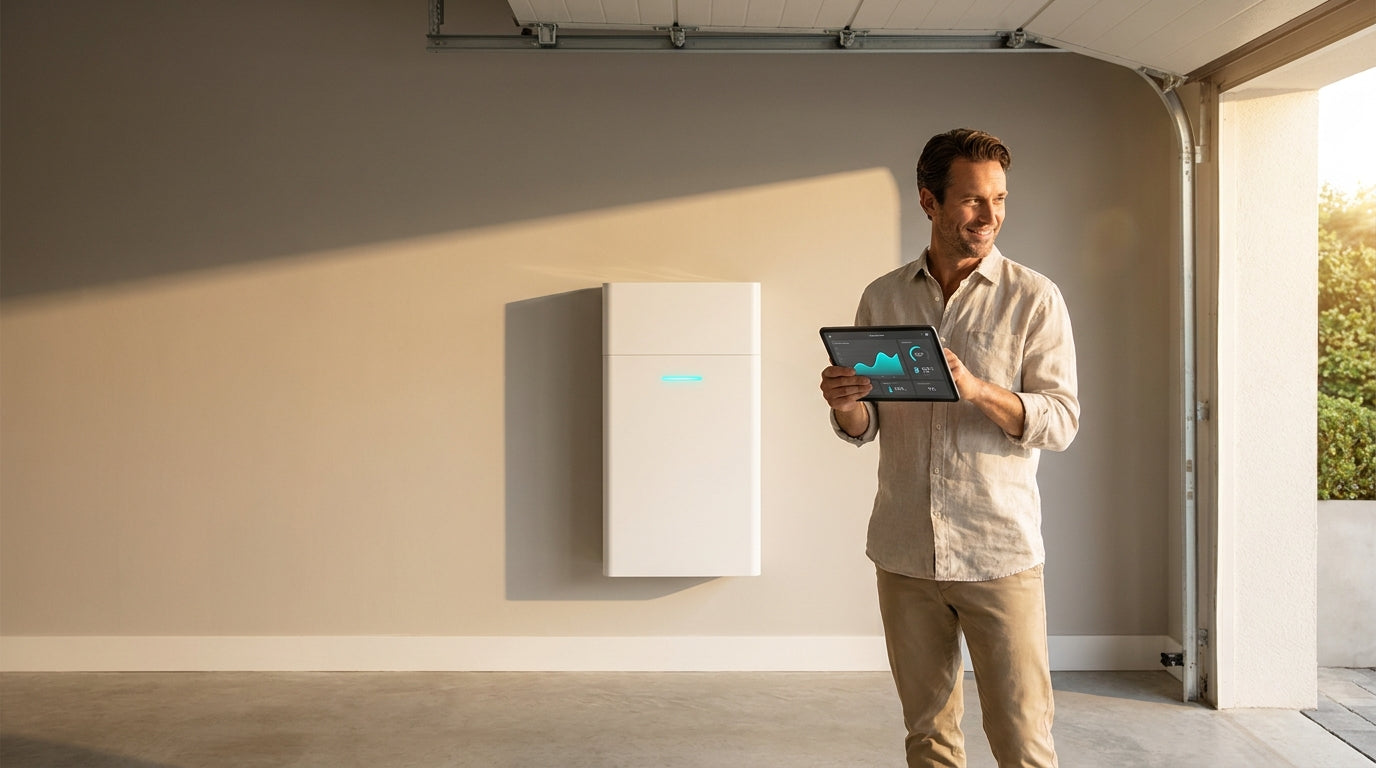
- A battery — specifically a dispatchable home battery, ideally LFP (lithium iron phosphate — the safer, longer-lived battery chemistry). This is the asset that stores cheap power for Tier 1 and supplies VPP events for Tier 3. Kora Powerblocks is built for this role.
- A smart panel — circuit-level monitoring and control so the system knows exactly when to charge, discharge, hold for a VPP event, or back up your home during an outage. Without intelligent control, you can't optimize across three tiers simultaneously. That's the job of the Kora Smart Panel.
- A VPP enrollment platform — the software layer that actually bids your spare capacity into grid programs and collects the payments. This is what turns a battery from a backup device into an income-earning asset. (This is the role Kora Energy Trading — a planned Kora feature, in development and not yet available to earn from — is designed to play in our 4-in-1 system.)
Kora Powerblocks scale from 4 kWh to 112 kWh, so you can size the system to your budget and to how many revenue tiers you want to reach. You can see transparent pricing for each storage configuration on the Founders Edition product page.
A note on safety: any system that ties into your home's electrical panel and exports to the grid involves a grid-interconnection agreement and panel-level work. Always have installation and interconnection performed by a licensed electrician — this is not DIY territory, and your utility will require certified work for VPP enrollment anyway.

So, can you really make money? The bottom line.
There's no one-size-fits-all answer, because the math bends to your state, your rate plan, and which programs you can join. But the verdict is clear: with solar export credits alone, you'll barely break even in 2026 — and in NEM 3.0 territory you might not even do that. Stack a battery and smart panel that reach all three tiers, and the answer flips to a confident yes. Self-consumption shrinks your bill, export credits trim it further, and VPP payments turn your battery into something that pays you back in cash — often hundreds to over a thousand dollars a year [6].
The hardware is the whole story. A panel alone exports cheap power for pennies. A battery with intelligent control captures all three tiers at once.
See what the Kora 4-in-1 system — Smart Panel, Powerblocks, the Power App, and the planned Kora Energy Trading — costs for your home → Reserve your Founders Edition.
No guaranteed savings or earnings. The VPP and income figures in this post are third-party program terms that change frequently; Kora Energy Trading is planned and in development, not a feature you can earn from today.
References
- U.S. Energy Information Administration, Electricity Monthly Update (end-use section), residential average price 18.83 cents/kWh, +10.2% year over year, March 2026. https://www.eia.gov/electricity/monthly/update/end-use.php ↩
- EnergySage, Net Metering 3.0: California's NEM 3.0 Explained — value of net-metering credits reduced ~75% under NEM 3.0, exports valued at ~25% of retail rate. https://www.energysage.com/blog/net-metering-3-0/ ↩
- Stellar Solar, SDG&E Net Metering in 2026: Rate Structures Explained — SDG&E Solar Billing Plan values exports by hourly grid value rather than retail-rate netting; current 2026 export pricing files published by SDG&E. https://stellarsolar.net/2026/03/02/sdge-net-metering-in-2026-rate-structures-explained/ ↩
- U.S. Department of Energy, Virtual Power Plants Projects — 30–60 GW current VPP capacity; 80–160 GW potential by 2030; ~$10B annual grid cost savings potential. https://www.energy.gov/edf/virtual-power-plants-projects ↩
- Sunrun Inc., Sunrun Builds the Nation's Largest Distributed Power Plant… (investor press release) — 106,000+ enrolled customers across 17 programs, nearly 18 GWh dispatched, $17M+ earned by customers, 416 MW combined peak output, 2025. https://investors.sunrun.com/news-events/press-releases/detail/361/sunrun-builds-the-nations-largest-distributed-power ↩
- Clean Energy States Alliance (CESA), Virtual Power Plant Programs Summary Table — ConnectedSolutions MA $275/kW per season (max $6,875/yr); Xcel CO Renewable Battery Connect $350/kW AC upfront (cap $5,000) + $100/yr; CA SGIP $0.15–$1.00/Wh; CA DSGS $62.10–$82.80/kW with 30% 2025–2026 bonus. https://www.cesa.org/projects/energy-storage-policy-for-states/virtual-power-plant-programs-summary-table/ ↩
- Internal Revenue Service, Residential Clean Energy Credit (Section 25D) — credit available for property installed 2022 through December 31, 2025; "not available for any property placed in service after December 31, 2025." https://www.irs.gov/credits-deductions/residential-clean-energy-credit ↩
- Stoel Rives LLP, The One Big Beautiful Bill Modifies Renewable Energy Tax Credits — Section 48E phase-out "does not apply to the ITC with respect to energy storage technology." https://www.stoel.com/insights/publications/the-one-big-beautiful-bill-modifies-renewable-energy-tax-credits ↩
- Texas Administrative Code, 16 TAC § 25.509, Scarcity Pricing Mechanism for the ERCOT Power Region — high system-wide offer cap (HCAP) of $5,000/MWh for energy offers, with a low cap of $2,000/MWh; under ERCOT's RTC+B market changes (live December 5, 2025) the day-ahead system-wide offer cap is $5,000/MWh and the real-time cap is $2,000/MWh. https://www.law.cornell.edu/regulations/texas/16-Tex-Admin-Code-SS-25-509 ↩



Share:
Will the Grid Hold This Summer? A 2026 Heat-Season Home Battery Prep Guide
LFP vs. Sodium-Ion Home Battery: Why LFP Wins in 2026 (And What the Natron Collapse Tells You About the Wait)